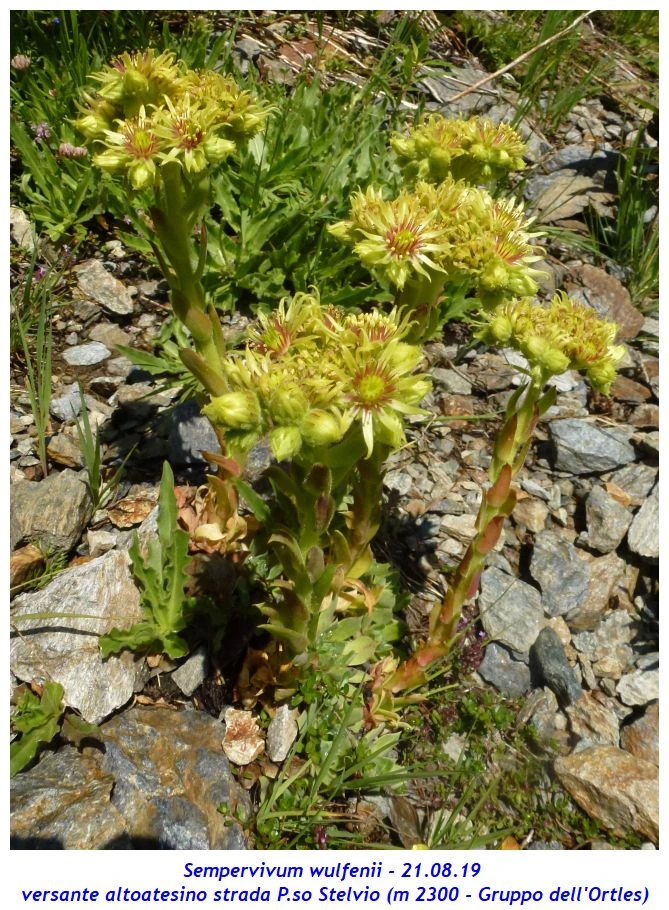

Sempervivo wulfenii
- Endemism
Striking but rather rare, this species is endemic to the central-eastern Alps, where it is found on cliffs and in dry, stony habitats, on predominantly siliceous soil. The plant grows at altitudes between 1,400 and 2,600 metres; in Italy, it is found from Friuli-Venezia Giulia to Lombardy. It is therefore not present within the National Park.
Belonging to the Crassulaceae family, otherwise known as succulents, it is easily recognisable and cannot be confused with other houseleeks due to its corymbose inflorescence bearing golden-yellow flowers. It forms characteristic basal rosettes composed of fleshy leaves that are glaucous and reddish-purple at the base, pointed and with ciliate margins.
Although similar to Sempervivum grandiflorum, which is endemic to the Western Alps and also has yellow flowers, the two species cannot be confused, as their ranges do not overlap.
Succulent plants, sometimes incorrectly referred to as ‘fatty plants’, are plants which, in order to adapt to arid climates, have developed specialised tissues for the accumulation and storage of water. Furthermore, the genus Sempervivum has adapted to survive for many months under the snow, managing to protect its leaves (and its water reserves) from freezing.
Bibliography: Costanzo M. IL giallo del semprevivo giallo. Cactus & Co. FAB - Gruppo Flora Alpina Bergamasca