
Primula marginata
- Endemism
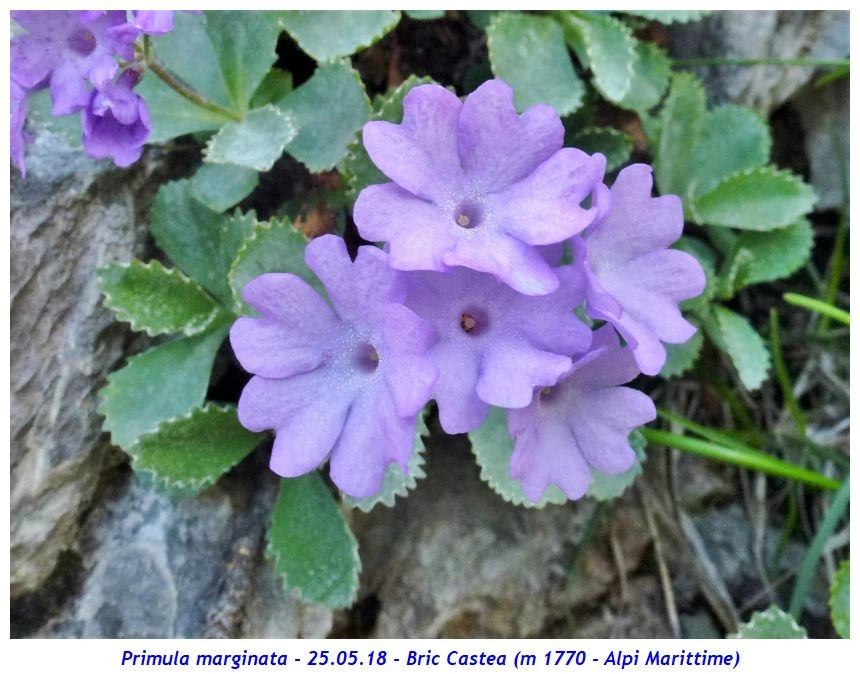
This primrose is sub-endemic to the south-western Alps; that is to say, it is not entirely restricted to that area, as it is also found in a few localities in Emilia, in the northern Apennines. Primula marginata is a plant that prefers rocky, scree-covered and debris-rich habitats, particularly those with limestone, at altitudes between 900 and 2,900 metres. It is not found within the National Park.
A perennial plant, it has distinctive fleshy leaves with serrated edges, often of a silvery-white colour which may also cover the entire leaf. This colouration of the leaves is the origin of its common name ‘impolverata’ (meaning ‘dusty’), and is caused by calcareous secretions resulting from the plant’s excretion of excess calcium carbonate.
The flowers, which are purplish-violet and large in relation to the stem bearing them, are arranged in erect umbels comprising between 2 and 8 flowers. Primula marginata is easily distinguished from other red-flowered primroses by its white-edged leaves.
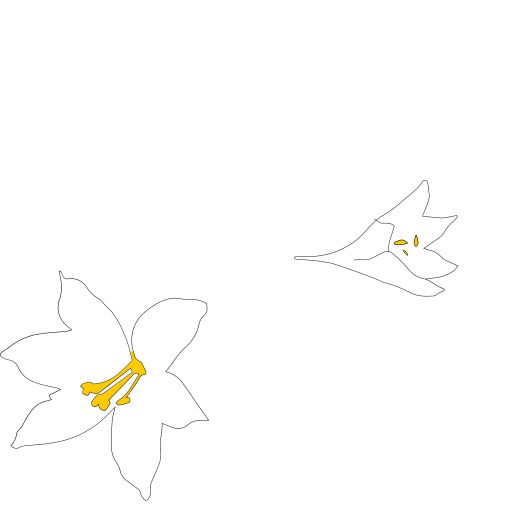
In natural populations, this species features a near-equal coexistence of short-styled and long-styled individuals (heterostyly) to promote cross-pollination.
The genus Primula comprises many species that produce large quantities of nectar. However, due to the elongated corolla tube, only insect species equipped with a long proboscis (the insect’s sucking apparatus), such as bumblebees and butterflies, are suitable as pollinators of primroses. Bees, however, use a trick to reach the nectar: they bore a small hole in the corolla tube from the outside.