


Plant species
Listen to audio
Jovibarba allionii
- PNGP
- Endemism
Jovibarba allionii
(Jord. & Fourr.)
screes and arid areas
July - September
Subalpine, Alpine
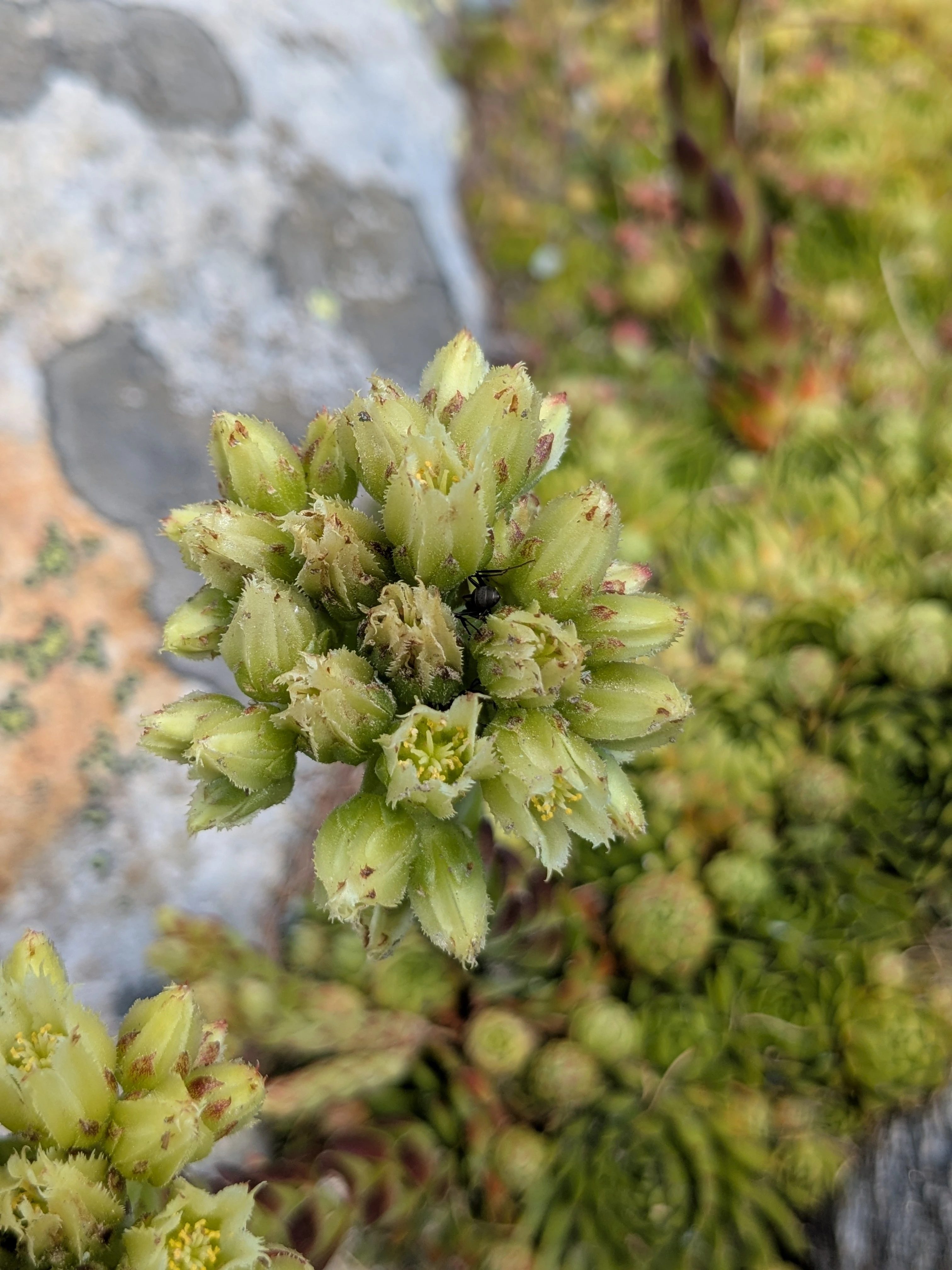
A species endemic to the Western Alps, in Italy it is found exclusively in Piedmont and, with just a few specimens, at a single site in Liguria. In both regions, it is a strictly protected species, included on the respective regional Red Lists. Belonging to the Crassulaceae family (the so-called succulents or ‘fatty plants’), it prefers rocky, acidic, non-calcareous soils (calcifuge plant). It is found mainly on granite, gneiss and sandstone at altitudes between 1,200 and 2,400 metres.
A low-growing, perennial herbaceous plant, it forms rosettes of light green leaves with pointed tips, sometimes with a reddish tinge at the tip. It produces an inflorescence in which the individual yellow, bell-shaped flowers are arranged in a corymb.
It belongs to the group of succulent plants (also incorrectly referred to as ‘fatty plants’); that is, it is a plant which, in order to adapt to arid climates, has developed specialised tissues for the accumulation and storage of water. Given its hardiness, it is often used as an ornamental plant.
The species is named after Carlo Allioni (1728–1804), a Turin-based botanist and author of the seminal 'Flora pedemontana' (1785), which is still regarded today as one of the major European works on flora and the most important in Piedmont. As a testament to his botanical studies, his herbarium, comprising well over 11,000 different species, is preserved at the Turin Botanical Garden.